Project detail
LifeAnswerz
Designing anf building an end-to-end system that translates expert numerology logic into a usable digital product.

Context
LifeAnswerz is a numerology consultancy platform where a professional numerologist offers consultations to clients.
The platform combines:
Expert-led services
A digital tool that supports analysis and interpretation
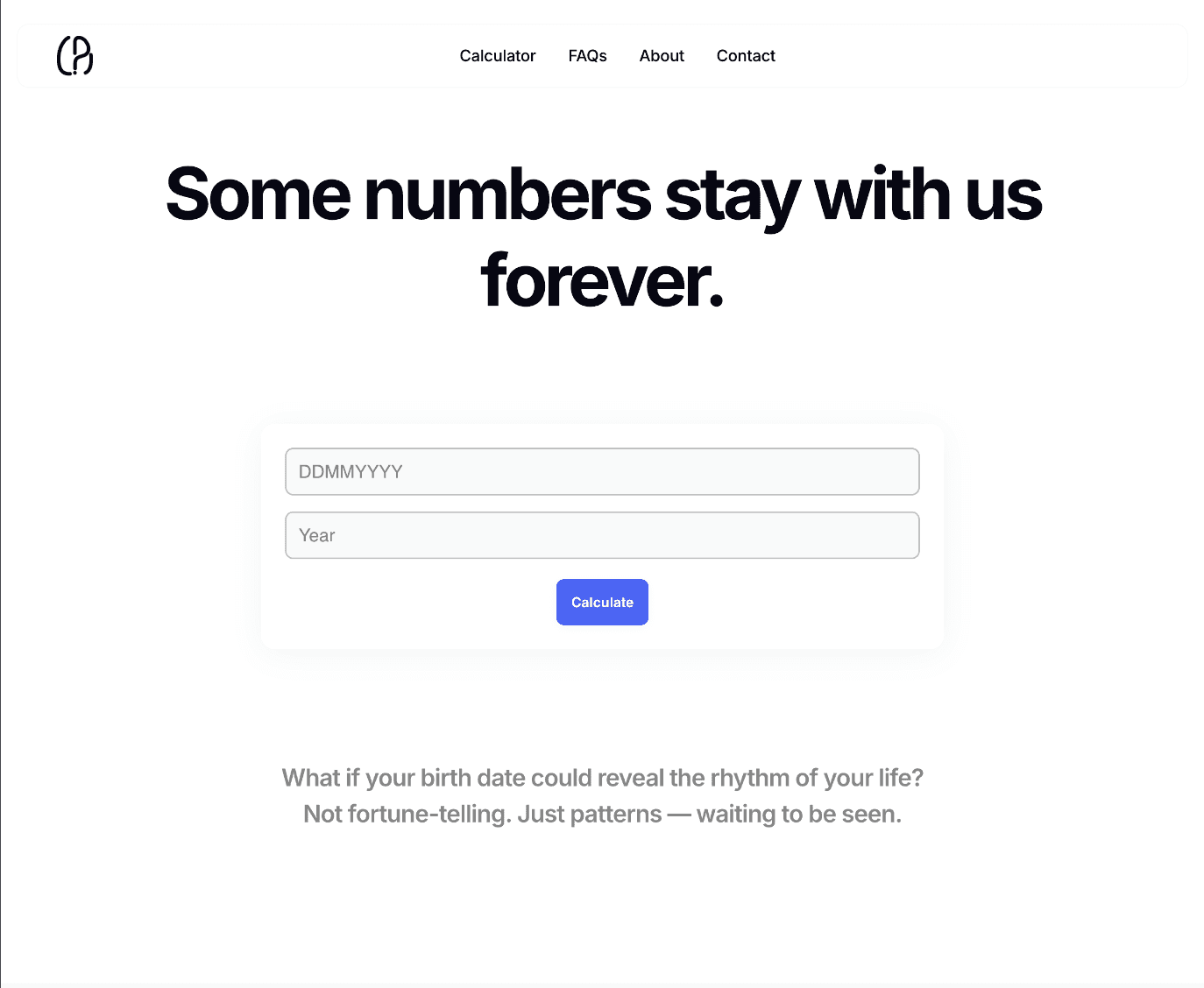
I worked on designing the platform and built a numerology calculator that became a core internal and external support tool.
The problem
In consultancy-driven domains, much of the logic lives in the expert’s head.
For numerology, this meant:
Calculations followed structured rules, but were applied through experience
Logic was not formally documented as a system
Manual calculation was time-consuming and error-prone
The challenge was not to replace expert judgment.
It was to support it with a consistent, transparent system.
User Persona
Name: Priya Sharma | |
|---|---|
Goals:
| Pain Points:
|
My role and scope
This was a high-ownership project. I:
Designed the LifeAnswerz website
Worked closely with professional numerologists
Translated numerological principles into a computational system.
Built the calculator backend and integrated it into the frontend
I was responsible for design, logic translation, and technical execution.
How I approached the problem
I treated the calculator as a decision-support system, not an answer engine.
Before building anything, I focused on:
Identifying required inputs
Understanding how experts derived meaning from numbers
Mapping edge cases where interpretation mattered most
I asked experts to explain why certain numbers were emphasized, not just how they were computed.
This helped separate calculation from interpretation.
Key system insight
Accuracy alone was not enough.
The system needed to:
Produce consistent results
Be understandable to non-experts
Still leave room for expert interpretation
Designing the calculator system
I structured the calculator into three clear layers:
Input layer
User-provided data with early validation to avoid downstream errors.Computation layer
Deterministic rules that handled core numerological calculations.Interpretation layer
Structured outputs that experts could build narratives around.
This separation made the system easier to maintain and extend.
Technical implementation
The calculation logic was implemented as a backend API. I:
Wrote the core logic in Python
Made the computation system accessible via an API
Integrated it into Framer using a custom component and code
This setup allowed:
Independent iteration on logic and design
Clear separation between presentation and computation
Designing for expert and non-expert use
The same calculator needed to serve different users.
Instead of building separate tools, I designed one system with flexible depth of use.
Non-professional users could:
Enter basic inputs
Receive structured results
Experts could:
Use the calculator as a verification and support tool
Apply their judgment on top of consistent outputs
This kept the system consistent while respecting domain expertise.
Outcome
The calculator became a key support tool within the LifeAnswerz platform.
It helped:
Reduce manual calculation effort
Standardize logic across consultations
Reflection
This project strengthened how I think about encoding expert knowledge into systems.
It showed me that building tools for consultancy workflows is less about automation and more about supporting human reasoning.